No items found.
No items found.
What do you think of when you hear the word “accountability”? For many of us, it brings up some negative associations—blame, finger-pointing, or failure. But what if we got it all wrong? What if accountability isn’t about punishment but instead the foundation of trust, performance, and real leadership?
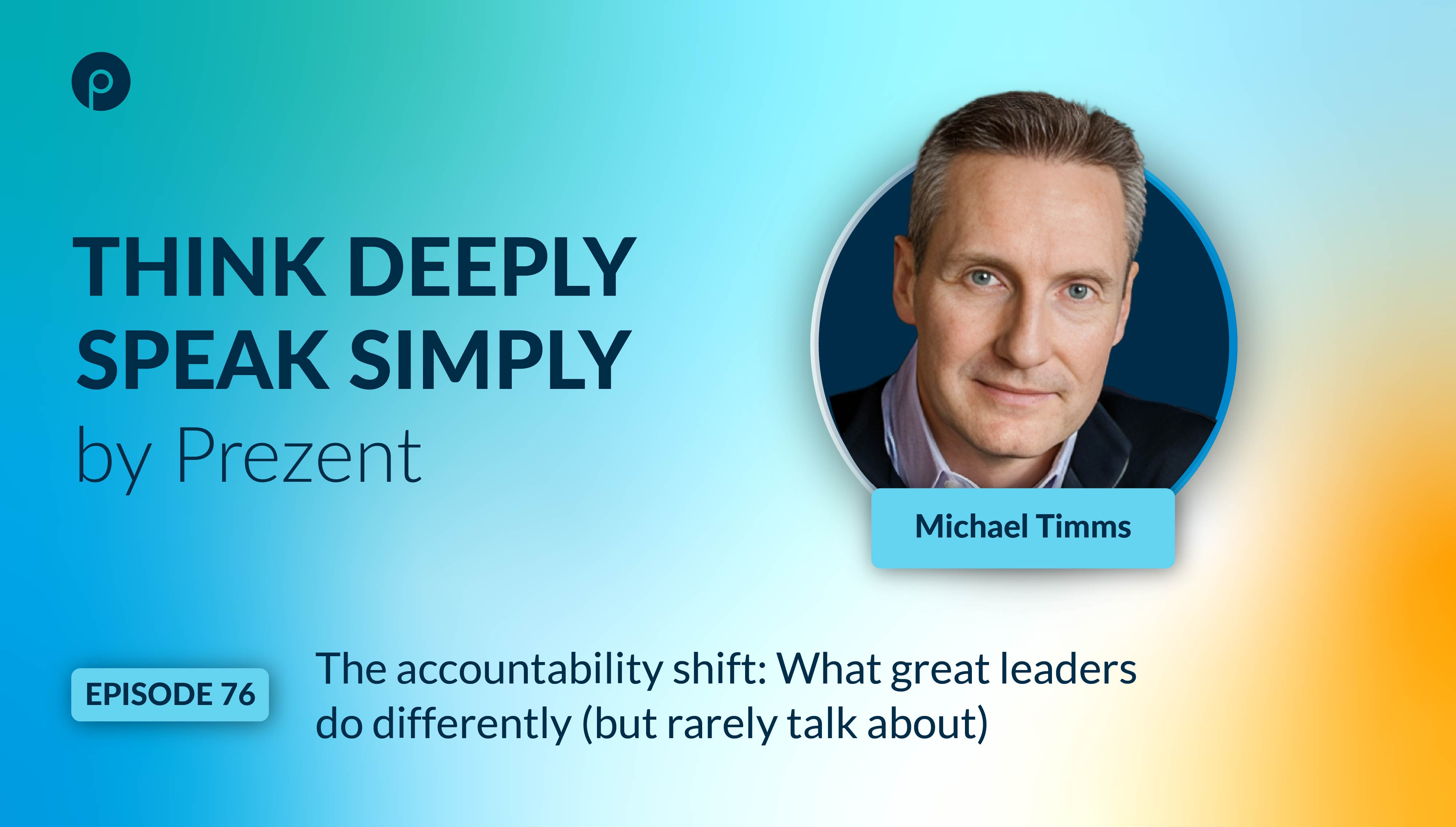
That’s exactly what we explore in this episode of Think Deeply, Speak Simply, where Rajat Mishra, CEO of Prezent, sits down with Michael Timms, a leadership consultant, TEDx speaker, and author of How Leaders Can Inspire Accountability.
Michael helps organizations move from a culture of control to a culture of ownership. In this conversation, he shares how leaders can communicate accountability in ways that empower instead of intimidate.
This isn’t just a conversation about fixing problems. It’s a practical guide to building better leadership habits.
Michael began his career in HR, working with multiple organizations. But after reporting to a series of increasingly bad managers, one in particular left a lasting impression, for all the wrong reasons.
“I just wanted to make sure nobody feels the way that guy made me feel.”
That moment became a turning point. Michael left corporate life and started his consulting firm. Initially focused on succession planning, he began to notice a pattern: in every story of strong leadership, there was a common theme—and that was accountability.
But not the kind tied to pressure or control. The kind where leaders lead by example, create clarity, and build systems where people take ownership willingly.
When Rajat asks Michael to define accountability, his answer is both clear and refreshing:
“Accountability is taking ownership of results and focusing on what you can do to improve future results.”
Too often, leaders confuse accountability with merely completing tasks. But as Michael explains, that’s actually responsibility. True accountability is about delivering results—and owning them, good or bad.
The problem? Most leaders instinctively think accountability issues are “out there”—with the team or another department. Rarely do they ask, “Could this start with me?”
Michael runs exercises with executive teams to reveal this exact blind spot. And once they realize it, everything shifts.
“When leaders take ownership first, others are far more likely to follow.”
One of the most thought-provoking distinctions Michael makes is between responsibility and accountability.
When leaders focus too much on how something should be done, they create dependency instead of initiative.
To explain this, Michael uses a simple analogy. Imagine asking someone to get bread, milk, and eggs. If you provide detailed instructions—such as the route to take and the car to drive—any small obstacle (like a dead battery or a road closure) might lead them to give up.
But if you just say, “Get these items because we’re making French toast,” they’ll figure it out.
“It’s not about prescribing the steps. It’s about clearly defining the outcome—and why it matters.”
This mindset applies to teams, too. Michael shares how his daughters each have a post-dinner kitchen task. They all complete their part, but the kitchen still ends up messy. Why? Because no one owns the outcome of a clean kitchen. Just their piece of the puzzle.
Shared accountability begins when everyone understands and cares about the end goal.
So, how do leaders talk about accountability without making it feel like punishment?
Michael offers a powerful mindset shift: “Communicate like a detective, not a judge.”
Instead of walking in with assumptions or blame, come in with curiosity. Say, “This didn’t go as expected, can you help me understand what happened?”
This creates psychological safety, where people aren’t afraid to admit their mistakes or discuss challenges. And it helps move conversations from confrontation to problem-solving.
Michael also draws from systems thinking with this reminder: “If you’re part of the system in which a problem occurred, you likely contributed to the problem.”
Before pointing fingers, great leaders ask themselves, “What was my role in this?” It might be unclear guidance, missed context, or not setting the right expectations. That humility opens the door for honest conversations—and much better results.
Rajat captures it well: “It becomes a discussion about improvement, not a blame game.”
Toward the end of the episode, Rajat launches into a rapid-fire round with Michael. The answers are brief, but packed with insights:
What’s one word to describe great communication? Michael picks “clarity.” It’s what teams crave, yet often miss.
How is AI changing communication? AI is helping leaders say more with less. Michael notes how tools like Prezent can help trim clutter and retain only what matters, making communication sharper and more focused.
What advice would you give someone who’s presenting to senior leaders? Start with what matters the most. Use inductive reasoning. Executives want the recommendation upfront, then the supporting details.
What do you wish you knew when you started your career? “That taking ownership makes you stronger, not weaker.” This mindset lies at the heart of Michael’s leadership philosophy.
And the most common communication mistake? “Too much deductive reasoning,” Michael says. . That’s when people delay the main message by starting with too many details. He urges leaders to flip that: lead with the ask, then explain why.
This episode isn’t just about accountability. It’s about leadership that feels human. About trusting your team. About saying, “I own this” before asking others to do the same.
Michael reminds us that leadership doesn’t begin with control. It begins with clarity—with reflection. By asking better questions and focusing on shared outcomes.
So the next time a project slips or results fall short, resist the urge to assign blame. Instead, pause and ask: What outcome did we want? Did I make that clear? And how might I have contributed to this?
Because in the end, accountability isn’t pressure. It’s power—shared, modeled, and communicated with purpose.
Missed the episode? Our podcasts are easily accessible on our YouTube channel. You can also listen on the go via your favorite platforms, including Spotify and Apple Podcasts.
New episodes of "Think Deeply, Speak Simply" are released biweekly, exploring the intersection of communication, leadership, and innovation.

Bharti is a product marketing writer at Prezent who believes great writing starts with deep reading. She began her career in finance, switched paths in 2019, and has since worked with Kintegra, Clearout, Miko, CaratLane, and, of course, Prezent. From content marketing to product marketing, she enjoys simplifying complex product and technical ideas without losing meaning. As she always says, “If it needs explaining twice, it needs better writing.”
Connect with her on LinkedIn.