Last Updated :
February 10, 2025
Raja Bothra

Craft a strategic business plan: Here is your guide to effective strategic plan development

Learn the essentials of a winning strategic business plan and set your company on the path to success.
team discussing on strategic business plan

Designing a strategic plan is one of the most critical steps in setting up a business. For the long-term success of a startup or an existing business, having a clear strategic business plan is like a roadmap that guides the business on its journey. It helps set specific goals, tackle challenges, and make the most of the opportunities that come your way. In this guide, we will break down the elements of a strategic business plan and explain why it matters so much. Whether you're thinking about long-term business growth, making big decisions, or simply aligning the team, a strong plan allows for effective business operations. This plan also helps identify new opportunities and gain a competitive advantage.

What is a strategic business plan?

A strategic plan is a detailed document outlining the company's overall direction, goals, and strategies, typically over one year (depending on the business). It serves as the blueprint for the business’s long-term success, defining where the company is heading, how it will get there, and the steps necessary to achieve its objectives within that time frame. By designing a strategic plan, you are setting a clear path forward, providing direction for the future, and ensuring that the efforts are focused on what matters most in the upcoming year.

Benefits of a business strategic plan

Why is creating a strategic business plan so important? The answer is simple: following a successful strategic plan helps the company run smoothly and grow sustainably.

  • Provides clear direction: A well-crafted business plan provides clear direction for the organization. It establishes a map that guides decision-making, helps businesses focus on short to medium-term goals within the set year, and ensures all efforts are aligned with the ultimate objectives. Without a defined strategy, businesses may experience confusion or inconsistency in the approach.
  • Aligns resources and efforts: The plan effectively aligns resources such as time, budget, and talent toward common goals. Different teams may pursue disparate objectives without a clear plan, leading to misallocation of resources and inefficiencies. By aligning all parts of the organization under a unified strategy, you create a strategic plan that ensures every department and employee is working toward the same vision.
  • Enables better decision-making: With a clear understanding of your business’s long-term objectives and market position, decisions can be made with greater confidence and consistency. It reduces the risk of making reactive or poorly considered choices, whether you’re considering partnerships, market expansions, or new investments.
  • Improves business resilience: Strategic planning helps businesses adapt to market changes and unforeseen challenges, which is essential for successful strategy development. By anticipating potential risks and opportunities, the plan ensures the organization remains agile, allowing for quick adjustments when necessary to maintain competitiveness and long-term success.

Design a strategic business plan using these 5 steps

A strategic business plan is key to guiding business owners toward long-term success. While it may take time and effort, following a clear strategic management process makes it easier to stay on track. Following these essential steps, you can design a plan that sets your business up for sustained success:

Step 1: Define your vision and mission statement

The vision and mission are the foundation of a strategic planning process. The mission statement clearly articulates the company's purpose, while the vision statement outlines the long-term aspirations. These statements guide business decisions and help ensure alignment across the organization.

  • Mission statement example: To provide high-quality, eco-friendly products that contribute to reducing carbon footprints.
  • Vision statement example: To become the leading provider of sustainable products by 2030.

These guiding principles reflect the company’s core purpose and serve as a source of inspiration as you develop the strategy.

Step 2: Conduct a SWOT analysis

SWOT analysis helps understand the business’s current position. Strengths and weaknesses should be assessed to leverage strengths in achieving business goals. It pinpoints strengths, highlights areas for improvement, and uncovers potential opportunities or threats that may arise in the future.

  • Strengths such as a talented team, unique intellectual property, or a well-established brand presence.
  • Weaknesses could be limited marketing expertise, over-reliance on one product, or outdated technology in the current business landscape.
  • Opportunities include expanding into new markets, forming strategic partnerships, or addressing emerging customer needs.
  • Threats could involve rising competition, changes in market trends, or regulatory shifts.

This analysis equips you with the insights needed to make informed, strategic decisions and focus efforts on areas that will drive long-term success.

Step 3: Set strategic goals and objectives

Based on the SWOT analysis, set specific, measurable, achievable, relevant, and time-bound (SMART) goals that the plan should include. These goals should align with the mission and vision and can be broken down into smaller objectives, all of which are to be achieved within the year.

  • Strategic goal example: Marketing plan - " Increase market share by 15% within the next year."
  • Objective example: Launch a new product line targeting millennials within six months.

These long-term goals are complemented by shorter-term objectives, which break down how to achieve the goals in a defined time frame. This combination of visionary goals and actionable objectives ensures the plan is inspiring and practical.

Step 4: Create an action plan

The next step is to develop a detailed action plan. This plan outlines the specific tasks, required resources, timelines, and individuals responsible for executing each strategic objective.

  • Break down each objective into actionable steps that align with the product or service offered.
  • Assign responsibilities to relevant team members.
  • Set deadlines and establish key milestones.
  • Determine necessary resources, such as budget, personnel, or technology.

Say the goal is to expand the customer base by 20% within the year, the plan might include:

  • Conducting market research in Q1 to identify new customer segments is crucial for the purpose of strategic planning.
  • Launching a digital marketing campaign in Q2.
  • Hiring additional customer support staff in Q3 to handle increased demand.

The plan serves as the roadmap for achieving your strategic goals, ensuring everyone is aligned and working towards common objectives.

Step 5: Monitor progress and adjust

Once the strategic plan is in motion, it's essential to monitor progress regularly (quarterly or bi-annually) to ensure the business is on track to meet the yearly goals. Establish key performance indicators (KPIs) as metrics to track performance.

  • Determine how frequently progress should be reviewed: quarterly, biannually, annually, or as part of the annual strategic review.
  • Track performance against goals and adjust strategies based on results or unforeseen changes in the business environment, considering the opportunities and threats.

The business environment and goals may evolve over time, and a successful plan needs to adapt to these new changes.

Present your business strategy using this strategic plan template

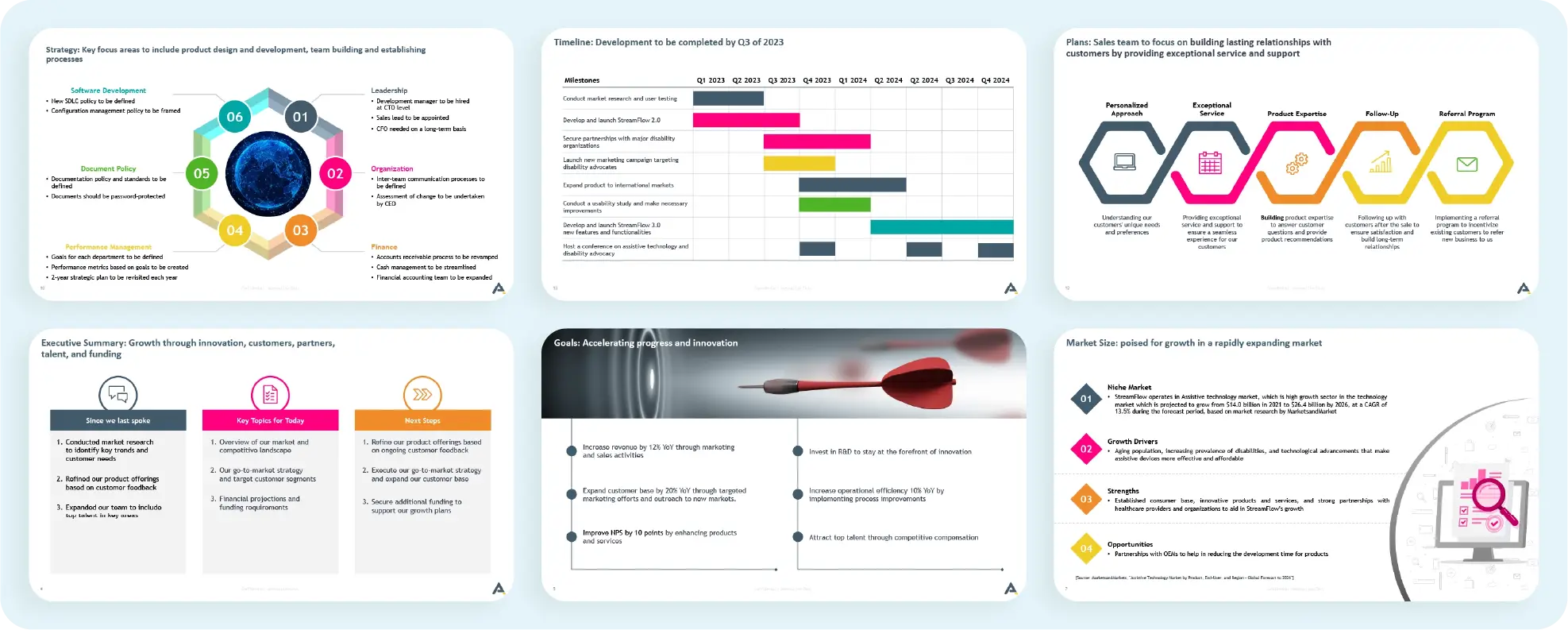
Presenting the business objectives is essential for aligning the team and stakeholders with your yearly goals. This strategic business plan template outlines the company’s mission, vision, goals, and plans. Defining key objectives and performance indicators ensures a focused approach to achieving long-term strategic success. The template provides a structured approach to help you communicate the strategy effectively. From executive summary to risk assessment, all under one umbrella, enabling better decision-making and resource allocation throughout the business.

Quickly develop a business strategy presentation with Prezent

Prezent, an AI-powered business communication platform, streamlines the process of crafting compelling presentations. Here’s how it can enhance your business strategy presentations:

  • Effortless slide creation: The Auto-generator feature allows you to easily create on-brand slides by simply inputting basic prompts, making it faster to start your presentation. It enhances the process of creating impactful presentations for your strategic business plan.
  • Craft engaging narratives: With the Story Builder, you can seamlessly incorporate compelling business stories from over 1,000 ready-to-use templates, ensuring your message resonates with your audience.
  • Customizable slide library: Prezent’s vast library of over 35,000 professionally designed slides lets you select data visualizations and customize them with your funding details, creating an informative and visually engaging presentation.

With Prezent, you can save time, enhance engagement, and produce polished business strategy presentations that effectively communicate your vision to investors. Explore more exciting features of Prezent AI by scheduling a demo with our experts. Learn how Prezent can help you create a business plan quickly and efficiently. You can also explore the platform yourself with a free trial.

Ready to create impactful presentations?

Try for free

About the author

Picture of Raja Bothra

Raja Bothra

Raja is the Growth Marketing Manager at Prezent, where he focuses on SEO, organic growth, and helping enterprise audiences discover smarter ways to communicate. He enjoys turning insights into meaningful marketing strategies, and when he’s not doing that, you’ll probably find him writing, a hobby he genuinely enjoys.

You can connect with him on LinkedIn.

No items found.
No items found.

Related resources

BLOG
Supriya Sarkar
April 1, 2026
The best B2B AI tools for enterprise teams: Features, pros and cons, pricing, and use cases
Find the best B2B AI tools for enterprise teams. Evaluate features, pricing, pros and cons, and use cases to choose tools that fit your workflows and deliver measurable impact.
BLOG
Niyati Mahale
April 1, 2026
11 best Genspark AI alternatives I tested for 2026
This guide covers the best Genspark AI alternatives for content, SEO, and presentations. Compare features, pricing, and real-world usability to find the right tool.
BLOG
Supriya Sarkar
April 1, 2026
What is presentation software? A complete guide to how it works, what to look for, and how to choose the right one
What is a presentation software? This guide explains how it works, key features to look for, and how to choose the best presentation software.
BLOG
Supriya Sarkar
March 31, 2026
PopAI review: Complete breakdown of features, pricing, and alternatives
PopAI review: Is this AI tool right for business presentations? Explore features, pricing, limitations, and enterprise alternatives.
BLOG
Niyati Mahale
March 27, 2026
Microsoft Copilot review for presentations: features, pricing & limitations
Explore Microsoft Copilot’s features, pricing, and limitations for presentations. See how it performs and whether it fits your workflow.
BLOG
Niyati Mahale
March 27, 2026
Adobe Review (2026): Is Adobe InDesign Worth It for Business Use?
This Adobe review evaluates Adobe InDesign’s features, pricing, and usability. See how it performs for business workflows and where it falls short.
BLOG
Niyati Mahale
March 27, 2026
Best AI Pitch Deck Generators in 2026 (Tested & Reviewed)
I tested the best AI pitch deck generators to see which tools actually help you build clear, structured, and convincing pitch decks faster.
BLOG
Supriya Sarkar
March 26, 2026
10 Best PopAI alternatives: Compare features, AI capabilities, pricing, and free plans
Find the best PopAI alternatives and AI presentation makers. Compare AI features, pricing, and free plans to create smarter, more professional presentations.
BLOG
Niyati Mahale
March 27, 2026
Best Plus AI Alternatives in 2026: Top 8 AI Presentation Tools
I tested the best Plus AI alternatives to see which tools actually create presentation-ready decks. Here are the top AI presentation tools worth using in 2026.
BLOG
Supriya Sarkar
March 27, 2026
Nano Banana review: Evaluating strengths, workflow gaps, and AI solutions for enterprise presentations
Nano Banana review for enterprise presentations. Explore visual strengths, identify workflow gaps, and see how teams use AI to build faster, executive-ready presentations.
BLOG
Niyati Mahale
March 27, 2026
11 Best SlideShare Alternatives for Sharing Presentations
Explore the best SlideShare alternatives for creating and sharing presentations. Compare tools for hosting, collaboration, design, and presentation analytics.
BLOG
Niyati Mahale
March 23, 2026
Beautiful.ai Review (2026): Features, Pricing, Pros & Cons
An in-depth Beautiful.ai review covering features, pricing, pros, and limitations to help you decide if it’s the right presentation tool for your needs.
Free 14-Day Trial*

Customized On-Boarding*